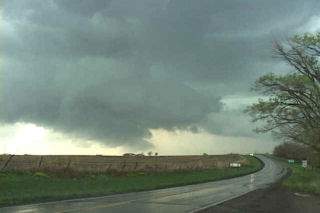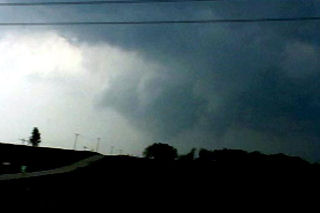

I must admit, this day caught me by surprise. We started in eastern South Dakota. After morning analysis and looking at model data, it appeared to be a respectable chance for large supercells in eastern Kansas with extreme instability and decent shear. As we arrived in Jefferson county, Kansas a supercell exploded from a small cumulus tower. Within 20 minutes the top was at 60,000 feet. Within another 30 minutes a tornado formed. This tornado narrowly missed the town of Oskaloosa.
May 10th & 11th, 2005 Supercells & Tornado
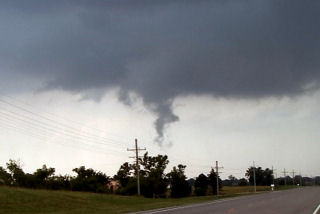
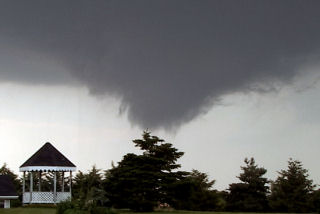
An interesting period for May 10 and 11. I captured an incredible mothersip supercell May 10 near Grand Island . This storm formed on the triple point and became one of the prettiest supercells, structure wise, that I had ever seen. It almost immediately started rotating and became severe quickly after it formed. There were many reports of tornadoes with this storm, none of which I believe are true. It was fairly high based its entire life.
On May 11 we left Kearney mid morning headed south towards Stockton , Kansas . When we arrived it was 81/68 with a nice southeast wind early afternoon. We watched as soft towers would go up and get sheared over. We ended up chasing the cell that was tornado warned northwest of Stockton . These cells were high based, and not very organized. As they crossed front, they became even more elevated and did not much of anything.
Mid afternoon we blew of this junk and headed west to the triple point as cell exploded there. We arrived near Benkelman and came over a hill to catch a glimpse of a weak skinny tornado west of town. The storms looked linear somewhat with a shelf cloud racing northeast. Updrafts were visible behind the shelf. Then something weird happened. My temp and dewpoint went from 63/59 to 71/64 in a matter of 1 minute. All of a sudden an updraft base starting rapid cascading motion, then rapid anticyclonic twisting and turning. Then a loud waterfall sound formed and a few seconds later a tapered cone funnel formed almost overhead. As quick as all the happened, less than a minute, a debris cloud formed in a field just to the southwest of the van. RFD hit the van on the NORTH side of the tornado, which we determined WAS anticyclonic!
We blasted north away of this northeast moving tornado as condensation developed to the ground. Our view out the west side of the van was one of condensation lifting with multiple vortices twisting and turning as debris, old corn stalks and tumbleweeds went flying up and rapidly rotating around the vortex! This tornado was no more than 100 yards from us and closing. We drove at a fast pace to get away from this tornado and managed to get a quarter mile away and we stopped. It immediately dissipated as the funnel rapidly vanished. This entire sequence happened in 3 minutes!
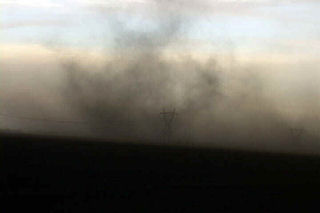
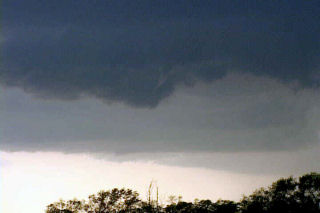
April 10th, 2005 St. John, Kansas Supercell & Funnels
April 10 was a day I wouldn’t soon forget. We had to leave Denver early to escape a raging blizzard. We were able to get out in front of it and into the warm sector under sunny skies. This was a tough day forecast wise for me as it looked like the dryline bulge would be the place to play. We later discovered too much dry air and a perpendicular orientation of the mid level winds to the dryline would cause the storms to form in a line instead of discreet supercells. Too much dry air never let the storm updrafts get organized for long periods. Later we also found out about the tornadoes in Trego county, to our north. We had actually taken off from the Pratt area to head back north and play that spot, but changed our minds. Live and learn. Thank goodness it is early season!
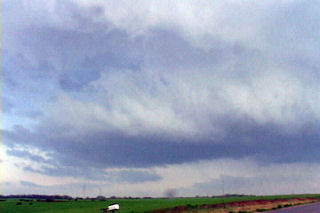
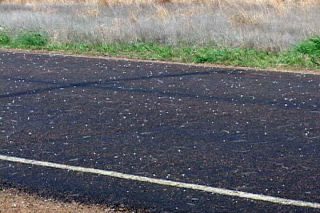
March 20-21st, 2005 Kansas & Oklahoma Supercells & Tornadoes
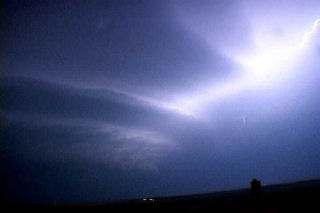
The weekend of March 20 and 21 shaped up to be an active period as a deep negative tilted trough developed and pushed south across the southern plains. I couldn’t resist the first chase of the year and I am glad I didn’t! Caryn, Colton and I left Sunday afternoon for what hoped to be elevated supercells in Kansas, then into Oklahoma for tornadic supercells the following day. The atmosphere did not disappoint. An elevated supercell produced copious amounts of CG and hail near Rush Center, Kansas during the evening of the 20th. On the 21st we targeted the area just east of Oklahoma City. By mid afternoon an awesome supercell developed and produced 4 confirmed tornadoes, 3 of which we captured on video. The first tornadic circulation developed almost overhead and developed a nice funnel followed by a debris cloud less than 200 yards from the van. The second tornado was a nice multivortex tornado that lasted about 5 minutes. The 3rd was a small rope tornado that we weren’t able to capture on video. The last tornado, was a LARGE cone, that we tried desperately to catch but just couldn’t due to road options.
May 29th, 2004 Concordia, Kansas Area – Tornadic Supercell
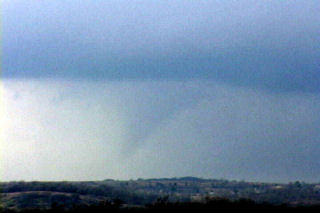
The setup May 29 was classic. A strong dryline surge was coming into Kansas. A surface low was developing with a triple point in north central Kansas. Moisture was spreading northward and would wrap around the surface low. By late afternoon, cumulus towers developed west of Concordia. It didn’t take long for an intense supercell to form and track northeastward along the warm front. This storm produced at least 5 confirmed tornadoes, including one that would hit the town of Norway, Kansas producing widespread damage.
May 16th-17th, 2004 Central Kansas Supercells
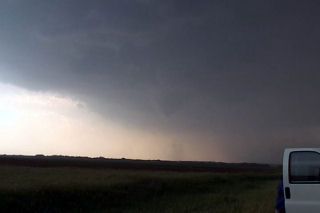
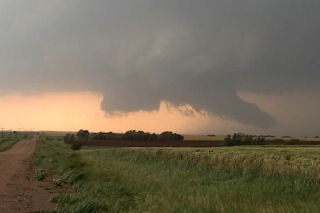
I was to play the boundary in central Kansas these two days. May 16 was a tough forecast with the greatest potential for tornadic supercells in Nebraska. We sat in North Platte till things got a bit clearer. We decided to head south into northern Kansas as heating and instability was best there. However, as we drove south of McCook a supercell exploded 45 miles to our east. Too late to catch this northeast (and soon to be tornadic) moving at 45 mph supercell. We continued our trek south. When we arrived at our target of Oakley, a beautiful rotating supercell was southwest of us. We core punched to get in front of it and encountered hail almost softball sized. It was incredible! We stayed south of this storm as inflow raged at a clocked 72 mph!! If dewpoints would have been mid 60s instead of mid 50s I am certain large tornadoes would have occurred. Near dark an absolutely gorgeous mothership supercell formed as we watched in awe. This storm had a nice funnel cloud but could not touch down and become tornadic.
The next day would have us continuing to play the boundary/triple point just west of Hays. By mid afternoon convection fired west of Hays and could not sustain itself. Finally a cluster of storms formed east of Hays from which a nice classic supercell tracked along I70 from Russell eastward. This storm tried very hard to produce a tornado, but couldn’t quite focus rotation strong enough in the updraft to do it. Several times rapidly rotating wall clouds would form only to dissipate as occlusion after occlusion occurred. Finally, near Wilson, the storm dissipated.
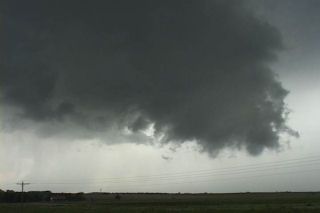
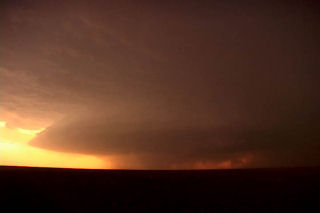
May 12th, 2004 Southern Kansas Tornadoes and Supercells
May 12 was to be the best of days and the worst of days. I arrived on the first cell to develop. We were sitting in Pratt as the dry line bulge kicked off the first respectable towers. However there were to be 4 cells this day and 3 of the 4 produced tornadoes. I was able to see the very first tornado, but missed the Attica tornado because I was still chasing the northern cell, which still had incredible structure. One storm chasing rule cost me, and that was to NEVER leave your storm unless you know it is dying or dead. And this cell wasn’t dying or dead. Finally, it crossed the cold front and became undercut, thus pretty much ending its tornado potential, so I blasted south and intercepted the Isabel cell, then caught the Anthony wedge (Harper county) at dark. This storm had incredible structure and looked like a striated soda can at dark. It was VERY electrified.
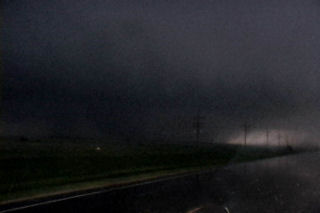
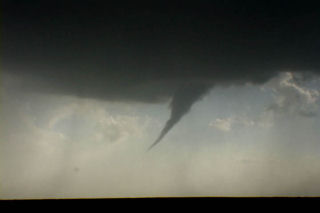
March 27th, 2004 Edwards County, Kansas Tornadic Supercell
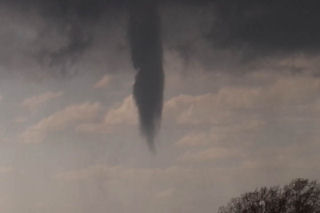
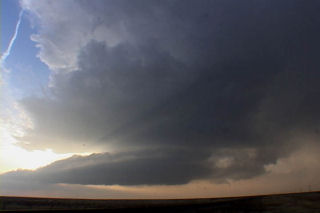
March 27 took me to southwest Kansas. A triple point set up was to be the focus for initial supercell development this day. Models showed a couple waves of convective development with the advancing trough and cold front with the dryline and triple point to be the focal point for potential tornadic supercells by late afternoon. However, the first wave of convection of the day, which developed late morning and early afternoon, was the only wave to happen. Fortunately I left early for my target of Dodge City, Kansas. After driving through blizzard conditions in Colorado, I got in front of the advancing cold front just west of Ogalla, Kansas on I-70. I dropped south to get to my target, and at the same time a supercell developed just east of Dodge City. This storm rapidly intensified and produced several tornadoes. I had to core punch the FF core to get to the updraft and managed to break my first windshield of the year with 2.5″ diameter hailstones. By the time I got to the updraft, the first LARGE tornado (F3) was dissipating. I managed to see it as it dissipated, but missed the biggest action by 10 minutes. Two other tornadoes and several funnels formed. Also included in the photos, was an LP supercell from the night before that my wife Caryn and I intercepted near Boise City, OK. Check out the photos below.
May 4th, 2003 Pierce City, MO Long-tracked Tornado
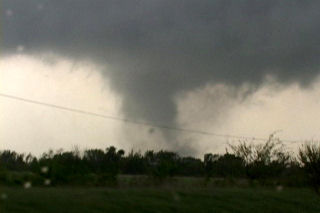
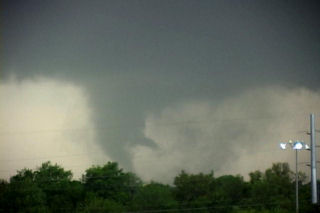
Unbelievable day in the southeastern plains today! We began the day in OKC, determined to consider playing the tail end of this system. My concern (in addition to storm motion) was that the best show might occur in a narrow and early window over SC-E Nebraska (16-19Z) and then it would be over. Upon waking and looking at the data, it became apparent that the setup was indeed outbreak-like and that therefore one could likely pick about any storm and expect to see large tornadoes. Analysis soon suggested that the cap would break explosively in the HCRs ( horizontal convective rolls – bands of congested cumulus from which the most important storms of the day often develop; these bands are generally oriented along the low-level shear vector ) embedded within the highly unstable, strongly sheared warm sector. Stopping in El Dorado for fuel we watched as our surface winds slowly veered and our dewpoint spiked lower. Surface analysis revealed an intense low-level dry punch surging inexorably eastward towards SE KS and NE OK. I couldn’t believe it when I downloaded the SPC STOR and saw the 8-11 values blanketing the entire risk area from SE NE to N TX.
We decided on the spot to target SE KS, first intercepting storms on the northern portion of the E KS theta-e tongue and then dropping southward on different storms. We drove east on Hwy 54 to Iola and then north on 169 to Welda, KS where we sat for close to an hour watching convective towers get shredded to bits. Radar downloads revealed an intensifying cell moving NE towards the area south of CNU; rather than jumping on that as soon as we saw the first reflectivity core in NE Osage County, Oklahoma we sat watching convective towers closer to us. However, as the cell slowly matured and moved into Chautauqa Co. (see the radar downloaded via cell phone at the time, shown in Fig. 6 below), we could no longer sit still as we became convinced that this storm would become a prolific tornado producer. Driving south and then navigating around the NE side of CNU, we dropped SE in a desperate attempt to get ahead of this incredible storm (radar shot at the time, Fig. 7). As we passed the junction of Hwy 57/59 driving south on Hwy 59, we drooled at the spectacle of the rock hard convective bomb to our ESE. Following the western edge of the updraft down to cloud base, we immediately spotted a classic stovepipe tornado spewing debris about 7-8 miles to our E, somewhere near or just east of the Neosho wildlife area. Cursing at our failure to jump right on this storm as quickly as we noticed it on radar, we drove east on 160 out of Parsons, quickly taking up the rear of a very long and very sloooow moving caravan of storm chasers. We busted north and east on Hwy 126 intending to eventually intercept the classic tornadic supercell east of Girard, KS at or near the MO border. I gasped at the radar depiction of the storm’s hook overtaking Girard and wondered what kind of devastation was in store for towns east of this storm.
We were making great time and might have actually outflanked the storm as planned. However, fresh radar downloads revealed a very good looking tail end storm in Nowata Co. OK and we became convinced that this storm would eventually go on to produce significant tornadoes provided the dreaded 80-mph left mover to its SSE didn’t interfere too badly (this bit of bad luck killed what might have been a strong tornadic storm the day before near Childress, TX). On the way south to intercept the OK storm, we quickly detoured to check out the updraft base of another supercell moving NE through Labette Co., KS and quickly spotted a truncated cone tornado emanating from cloud base to our distant west. The storm started to look a bit more organized shortly afterwards and we pressed south, worrying that the Labette Co. storm would be interfered with by the tail end Charlie and would too seriously detract us from intercepting the southern storm. Driving through scattered golf ball -sized hail in the FF core, we observed the updraft (completely separated from FF core) and immediately noticed a fat, nubby funnel cloud just NE of Fairland, OK (we later learned that this was a weak tornado but couldn’t see the ground-based circulation for all of the trees and hills). Soon thereafter, the storm became rather disorganized as it merged with the left mover. Nonetheless, we persisted chasing this storm noting that inflow was still quite strong and moist southeast of the RF gust front . The storm began to intensify and take on scary HP/classic hybrid characteristics east of Neosho (which was devastated by a tornado on 4/24/75). Racing east on Hwy 86, we attempted to get to Hwy 60 north of Newtonia but the storm’s horrendous looking rear-flank core soon overtook the road before we got there and, fearing very large hail and powerful winds, we turned around and continued E and SE on Hwy 86, eventually turning north on Hwy 37 at the town of Purdy.
All this time, we were experiencing the storm’s ambient inflow which was 76/66 on 1725 winds. A new radar download revealed that this storm had retained classic supercell character with a vengeance and we wasted no time at all getting north to Monett , MO. The clefted -out barrel-shaped meso of an incredible beefy tornadic storm revealed itself to us soon after turning north out of Purdy and, 1 mile south of Monett , we observed a very large strong/violent tornado just northeast of town. We turned east on 60 and for the next 35-40 minutes experienced one of the most thrilling and fascinating tornadic experiences I’ve had. We watched in amazement as this fat, inky black-blue tornado rampaged across the countryside between Monett and Verona, spewing huge plumes of dirt/debris skyward. The tornado morphed into a fabulously fluid and dynamic multiple vortex tornado with evolutions that are best viewed on video rather than described. We got closer and closer to this high-contrast, long-lived tornado, watching as it lofted debris into cloud base and fearing for all in its path. I relayed reports to people with access to NWS numbers the best I could. I fear the tornado hit the north side of Aurora, MO. At times we got as close as 2/3 of a mile from the tornado as we drove northeast on Hwy 60 and then east on farm road 2200 south of Marionville and then Hwy 173 east of town. We got farther south of the tornado than we would have liked by this time (after being so close for so very long) but we got view of it again beneath the center of the incredible ground-dragging, clefted mesocyclone SW of Springfield: now it was an intense looking high-contrast stovepipe tornado with a fan-shaped debris cloud near Battlefield, MO. We watched as the tornado endured a classic rope-out on the west side of SGF, sparing the fortunate citizens of that city a bad tornado disaster.
April 30th, 2003 Northwest Missouri Supercell & Funnel
OKC at 7:30, we made our way to Topeka, KS. My optimism regarding the potential for visible tornadoes had evaporated the evening before due to the upper-tropospheric wave responsible for surface cyclogenesis being progged to fill/weaken rapidly due to stretching deformation (a tendency apparently underestimated rather badly by most models 2-3 days prior to the event). Nonetheless, we were optimistic about the likelihood of HP supercell thunderstorms initiating along the frontal boundary from NE KS to S IA/N MO. The focus of our afternoon data analysis was on finding the likely initiation point and best environment for daytime supercells; NE KS to S IA is an unacceptably large target area when storm motion vectors are going to be 35-40 kt. We became convinced that initiation would be near Falls City, NE with rapid intensification and maturation of supercells across extreme NW MO. Our mistake was that we didn’t have enough confidence in this to set up shop downstream of the expected initiation point – there have been many times when I overshoot the area of initiation and have to backtrack westward.
We moved north from TOP on Hwy 75 at about 4pm CDT, observing congested (albeit mushy) CU and TCU to our NW through E. At the Hwy 36 junction we observed glaciated convective towers to our not too distant N and NNE; additionally, the developing congestus N through NW was being visibly undercut by scud apparently associated with the leading edge of the cold front, so we continued on eventually crossing into MO east of Falls City. When we turned north on Hwy 59 in east-central Holt county we could make out much cloud base structure associated with our target supercell. We observed a well-defined dry slot with developing RFD gust front; to the NE of that was a very ominous block-shaped lowering/wall cloud that definitely had a tornadic appearance. We were too far to discern any detail. We continued stair-stepping N and E and when we were just east of Maitland on CR A we observed a fully occluded wall cloud with truncated cone shaped funnel cloud about 4-5 miles NNW of our location; the wall cloud and accessory scud tags were wildly rotating and I estimate its location to have been close to the town of Skidmore; I don’t remember the exact time (too busy navigating to keep a log) but it was probably around 6-6:15pm and we were too distant to confirm/deny that the funnel cloud was actually a tornado. I would not be surprised if a large tornado occurred somewhere N or W of Skidmore.
Unfortunately, we had been effectively outflanked by the storm so could not achieve the desired position due E or ENE of the meso. New mesocyclogenesis was rapidly underway to our immediate ENE and the RFD gust front was loaded with vorticity and wild, fluid vertical motion. Soon thereafter, the storm tended more to HP characteristics and developed a menacing rear-flank core with encircling shelf cloud. However, it refused to give up on trying to develop a forward flank updraft/meso as inflow stratus continued to fly into the storm from the E and SE and scud rose and attached to cloud base at the E edge of the core. East of Conception Junction in eastern Nodaway County we were briefly overtaken by the southern edge of a tightly circular precip curtain, the apparent center of low-level circulation passing just to our north. Our winds turned from SSE to W, gusting to near 50 kt. We finally got to the junction of US Hwy 169 and CR O at Gentry. The storm was now decidedly HP in character with a substantial surging RFD core/gust front bearing down on us from the SW and a less menacing FF core to the NW; we were sitting in the notch at this crucial intersection with no more east option. To our immediate SW and almost overhead a patch of cloud base was swirling wildly as the RFD core pivoted around from the W and SW to overtake us.
The rotating cloud base moved quickly to our east across open pastures near Gentry, MO and we were forced north into the SW edge of the FF core, letting the more dangerous RFD core pass to our SE. After the maelstrom passed we once again attempted to outflank the storm but decided to blow it off at I-35 in favor of targeting a more isolated storm SE of STJ. Downloading radar as we drove (my goodness gracious, I never failed to get a wonderful cell phone connection yesterday), we headed directly to I-35 exit 40 at Lathrop. Too late (we heard the warming for the spotter-indicated tornado near Edgerton); it was an interesting looking soda can LP storm (we got 1″ diameter in the vault and cars were briefly blocking the interstate at an underpass) with an amusing array of sheriff deputies and other gawkers staring up at the sky. On the way south, we were mightily distracted by a ridiculously explosive convective bomb forming over STJ. As we drove south on the interstate we watched as the fat convective tower expanded, grew, overturned and went crazy. We turned around at Lathrop and stopped west of Cameron on Hwy 36 for a very entertaining lightning show (great anvil crawlers in the vault/overhead anvil). Stayed around until the storm lost supercellular characteristics and lined out.